




what is Nuclear medicine?
Nuclear Medicine is a medical and imaging specialty in which radiopharmaceuticals (molecules tagged with a radioactive marker) are administered to patients either for diagnosis or treatment of diseases. Once administered for diagnosis either by injection, oral route or inhalation, the patient is placed in a dedicated camera (SPECT/CT or PET/CT), which captures radiation emitted from the body to generate images of the radiopharmaceutical distribution. From these images alterations in biological processes can be identified and diseases diagnosed or monitored during treatment. Thirty-four FDA-approved, commercially available radiopharmaceuticals are available to image a variety of processes such as tumor metabolism, bone turnover, cardiac perfusion, brain function, pulmonary perfusion and ventilation, and endocrine functions. In other words nuclear medicine imaging is functional imaging informing us on the function of organs or disease processes.
The two main technologies used to generate these images are SPECT/CT and PET/CT. These are called hybrid imaging scanners because they combine a functional imaging tool (SPECT or PET) with an anatomic imaging tool CT (Computed Tomography) also known as a CAT scan. The combination of both allows for a more thorough assessment of disease and therefore unique diagnostic capabilities unmatched by any other imaging equipment.
The other aspect of nuclear medicine consists of therapies in which radioactive molecules are administered to patients for treatment of a variety of diseases such as hyperthyroidism, thyroid cancer, liver cancers, prostate cancer metastases to bone, neuroendocrine tumors and certain lymphomas.
Over 100 different imaging and therapeutic protocols are in place at UW Medicine to care for patients. The UW Division of Nuclear Medicine continues to develop new imaging protocols to address unmet clinical needs and to answer new clinical and scientific questions as they arise.
Strengths of our UW nuclear medicine division include:
- Unique technical capabilities at UWMC (1 PET/CT, 4 state-of-the-art SPECT/CT systems).
- Dual-trained technologists capable of performing both functional (PET, SPECT) and anatomic scans (CT).
- Tremendous clinical experience of nuclear medicine faculty in answering complex imaging questions.
- A much broader range of services offered than any other nuclear medicine division in the region. Our division ranks among the very best in the nation with continued clinical growth and diversification. This is underscored by the fact that top equipment manufacturers look to us and to our nuclear medicine faculty (physics and clinical) for input regarding the future of the discipline.
- A proven track record of clinical service excellence.
Overview
Our program trains board certified diagnostic radiologists trained in the United States or abroad who seek specialty training and US medical school graduates who seek Nuclear Medicine as a career.
The Division of Nuclear Medicine in the Department of Radiology at the University of Washington was established in 1962 by Dr. Wil Nelp. The division has had a successful postdoctoral training program since its inception. Its many graduates are now holding faculty positions in major academic centers and large private practices.
The current one-, two- or three-year residency program is designed in compliance with, and is approved by, the Accreditation Council on Graduate Medical Education (ACGME). Duration of training is dependent on prior experience. Our program provides a balanced and in-depth experience in all aspects of the basic sciences and clinical practice of nuclear medicine imaging and therapy. The program is approved for six (6) full time residents. Candidates must have completed at least one year of internship in the United States. Alternatively, they may be eligible for board certification in another specialty.
One year of Nuclear Medicine training is available to US-trained diagnostic radiologists who wish to pursue special competence in Nuclear Radiology from the American Board of Radiology (ABR) or receive American Board of Nuclear Medicine (ABNM) Certification. International Medical Graduates holding diagnostic radiology certification in their home country can also apply for one or more years of Nuclear Medicine training.
The Nuclear Medicine Division faculty bring extensive expertise in the clinical practice and basic science aspects of nuclear medicine. They are dedicated to teaching trainees to become strong nuclear medicine practitioners. Trainees learn how to integrate nuclear medicine diagnostic scans and therapies in the overall management of patients. Trainees are also provided many opportunities to become effective educators and independent scientific investigators.
The concept of integrative imaging is emphasized by our faculty. Trainees learn to identify imaging findings, characterize them, and to perform correlative imaging with other studies. This information is then integrated with signs and symptoms, type and timing of treatments, and trends in biomarkers in order to deliver an accurate, comprehensive and actionable clinical scan interpretation tailored to a patient’s condition. This approach is taught across the wide range of disease entities that nuclear medicine helps manage (cancer, neurological, pulmonary, cardiac, endocrine, bone, gastrointestinal, genitourinary, and hematologic disorders). In addition, trainees learn how to select the most appropriate imaging study to answer the clinical management question specific to each patient. Our program also teaches how to identify unmet clinical needs central to the development of new imaging strategies and the basis for research projects.
A close collaboration between basic science faculty and clinical faculty of nuclear medicine is at the heart of the division’s success. A comprehensive lecture and conference schedule complements the one-on-one clinical education that our trainees receive.
Mission Statement
Our mission statement echoes that of the University of Washington School of Medicine which is dedicated to improving the general health and well-being of the public. We are committed to training residents to improve the health of the public by the practice of Nuclear Medicine. Besides clinical excellence our trainees are supported in their scholarly activities that result in advancement of biomedical knowledge, publications, conference presentations, and CME lectures. The Nuclear Medicine services at the University of Washington Medical Center and affiliated sites foster significant uncompensated care to under-served populations in alignment with the overall goals of the UW School of Medicine.
Program Aims
We train residents in the practice of Nuclear Medicine to diagnose and treat patients using radionuclides. Residents receive instruction and experience that allows a graduated level of independence as they progress through their training. Research opportunities are available. At graduation residents are entirely competent to practice nuclear medicine independently. Our graduates have been able to transition to positions of service in the greater WWAMI region as well as other parts of the country. They have continued service to under-served populations as well as advancing academic Nuclear Medicine in major institutions across the country. Many have become educational leaders for future generations of physicians as well as contributing research within the field.
Facilities and Equipment
Each training site has a well-equipped nuclear medicine service with conventional gamma cameras, SPECT/CT scanners, and PET/CT scanners. In addition to nuclear medicine examinations, these systems are also used to generate contrast-enhanced diagnostic CT exams interpreted concurrently in the nuclear medicine service.
All sites, except the Puget Sound Veterans’ Affairs Hospital, are connected through an integrated PACS system (Visage Imaging) accessible remotely for the majority of on-call tasks.
Rotations
Nuclear Medicine residency training is provided at five (5) affiliated teaching hospitals in Seattle. These hospitals provide the volume and complexity of cases needed for a rich learning environment.
Fellows attend and present at multidisciplinary tumor boards and conferences, emphasizing professional interactions with radiology and clinical colleagues and providing compassionate patient care. Faculty members are experienced in Nuclear Medicine imaging and are recognized locally, nationally, and internationally.
UWMC-Montlake (UWMC-ML)
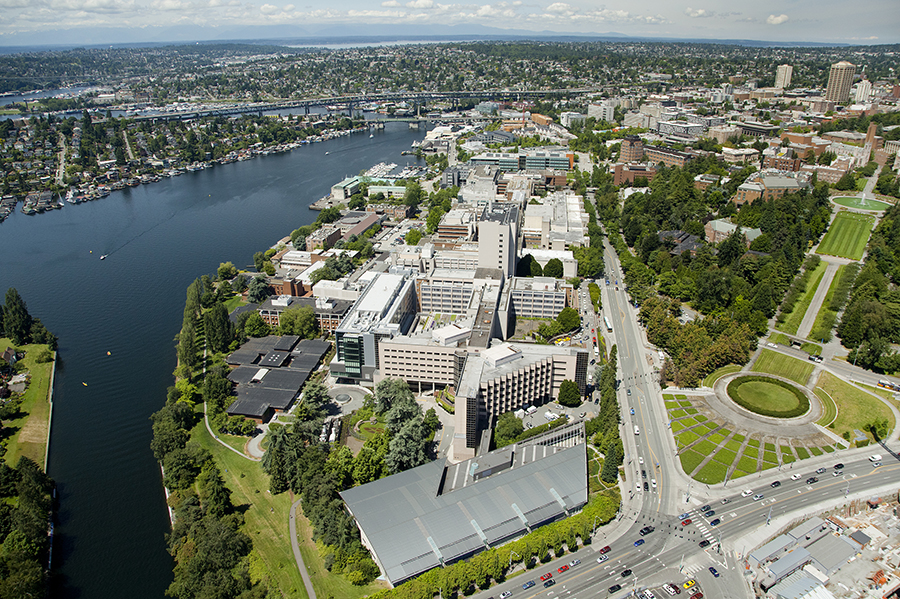
The University of Washington Medical Center-Montlake (UWMC-ML) is the largest facility in which our residents train. UWMC-ML is one of the foremost academic health centers, delivering exceptional, multidisciplinary care to a vast array of patients. UWMC specializes in tertiary care including organ transplantation, oncology, and cardiac disease and consistently ranks among the leading hospitals nationally.
Our residents rotate on five different services at UWMC-ML. Our three (3) Nuclear Medicine rotations include general Nuclear Medicine, PET/CT, and Nuclear Cardiology. Additional Computed Tomography learning experiences are provided in Abdominal Imaging and Cardiothoracic Imaging rotations.
Harborview Medical Center (HMC)
Harborview is a public hospital owned by King County and operated by UW Medicine. It serves patients from all walks of life including mission populations. HMC is the only designated Level I adult and pediatric trauma and burn center in the state of Washington, and serves as the regional trauma and burn referral center for Alaska, Wyoming, Montana and Idaho. HMC is also a Level 1 stroke and cardiac center.
Resident experiences include DEXA interpretation and QA/QI projects.
Seattle Children's Hospital (SCH)
SCH serves as the pediatric and adolescent academic medical center for Washington, Alaska, Montana and Idaho – the largest region of any children’s hospital in the country. SCH continues to be ranked among the top pediatric hospitals in the country by US News and World Report. Their goal is to provide hope, care and cures to help every child live the healthiest and most fulfilling life possible through superior clinical care and advance new discoveries and treatments through pediatric research.
Fred Hutch Cancer Center (FHCC)
The Fred Hutch Cancer Center, a National Cancer Institute-designated cancer center, brings together leading research teams and cancer specialists as a cooperative venture of Fred Hutchinson Cancer Research Center, UW Medicine, and Seattle Children’s Hospital. Researchers and physicians include several Nobel laureates.
Most of the outpatient cancer imaging is performed at FHCC, offering extensive training with a high caseload of oncology imaging with emphasis on cancer staging and treatment, and learning the appropriate nuclear medicine workup for various cancers. Fred Hutch clinics are actively involved in both cellular and non-cellular immunotherapy treatments, providing unique opportunities to learn about imaging assessments and complications associated with these new and emerging therapies. Residents participate in multidisciplinary case management conferences (tumor boards) during this rotation.
Veterans Affairs Puget Sound Health Care System (VAPSHCS)
VAPSHCS cares for Veterans from the Pacific Northwest, as well as serving as a referral center to other VA hospitals regionally. VAPSHCS has a reputation for excellence, innovation, and extraordinary care for our Veterans. This teaching hospital provides a full range of services, with state-of-the-art technology as well as education and research.
Research and Educational Activities
Residents have the opportunity to engage in research projects under the guidance of section faculty members during the academic year. The section has numerous active research programs, offering projects in basic science, clinical science, outcomes research, and quality improvement. These projects are expected to result in at least one scientific or educational paper in a peer-reviewed journal.
Please note that this is a clinically based residency program, and evaluations will focus on the six ACGME core clinical competencies rather than research.
Residents are expected to demonstrate teaching excellence by presenting at clinical case conferences throughout the year as well as presenting at journal club and protocol reviews in addition to participating in tumor boards. Teaching case presentations will be uploaded to our internal educational site.
How to Apply
Our Nuclear Medicine Residency program is currently recruiting for the 2027-2028 academic year.
We have a rolling application timeline, meaning that applicants can apply at any time. Applications are reviewed quarterly. Applicants will be notified if they have been selected for an interview.
How to Apply to the University of Washington Nuclear Medicine Residency Program
The American Board of Nuclear Medicine's requirements for Nuclear Medicine residency programs state that any applicant to a Nuclear Medicine residency program must have completed a minimum of one year of an ACGME-accredited postdoctoral clinical medicine training in the United States prior to enrolling in nuclear medicine residency. International medical graduates who are board certified in diagnostic radiology in their home country may be eligible for a waiver of this PGY-1 training year requirement.
We do not coordinate the PGY-1 year for candidates but will consider applicants who are currently enrolled and performing well in their PGY-1 training, or candidates who already have secured an upcoming PGY-1 training year. Acceptance in our Nuclear Medicine residency program will be contingent on the successful completion of the PGY-1 year.
All candidates should have passed USMLE Step 3 prior to joining our division.
To apply, please complete the UW Nuclear Medicine training documentation requested below to nmadmin@uw.edu.
Requested documentation:
For All Candidates
- NM Application form
- Current Curriculum Vitae (CV) (should include training history and relevant work experience with dates, publications and professional presentations, leadership and volunteer experience)
- A brief Personal Statement, addressing your interest in nuclear medicine and your career goals/plans (one page preferred, include name, date and signature). Please include date you are interested in starting training.
- USMLE scores (Copies of results for Steps 1, 2-CK and 3)
- Copy of medical school transcripts
- Copy of Dean’s Letter from Medical School
- Medical School Diploma (official copy with notarized translation if not in English)
- Documentation of PGY 1 year (as applicable)
- Documentation of completion of residency program (as applicable)
- Board Certification(s) (as applicable)
- Three current reference letters, dated and signed on department letterhead:
- One (1) from the director of your current residency/fellowship program
- One (1) from a radiologist familiar with your work
- One (1) from any physician that you worked with and has observed you professionally
For International Candidates (including Canada)
Submit above required documentation plus:
- OET exam (in lieu of USMLE Step 2- Clinical Skills (CS) exam)
- ECFMG Certificate (For applicants with Medical Degrees issued outside the United States/Canada)
Please do not send a photograph as part of the application process.
Please have professional references send original letters directly to the UW Nuclear Medicine Residency program to madmin@uw.edu at the time your application is submitted.
Letters of recommendation should be addressed to:
Fatemeh Behnia, M.D.
Director, Nuclear Medicine Residency Program
University of Washington Medical Center
1959 N.E. Pacific St., Box 357233
Seattle, WA 98195-7233
If you need further assistance, please contact our Nuclear Medicine administrator at: nmadmin@uw.edu
The University of Washington is committed to fostering an inclusive, respectful and welcoming community for all. As an equal opportunity employer, the University considers applicants for employment without regard to race, color, creed, religion, national origin, citizenship, sex, pregnancy, age, marital status, sexual orientation, gender identity or expression, genetic information, disability, or veteran status consistent with UW Executive Order No. 81.
We recruit trainees on the basis of merit. All candidates are considered without bias towards race, gender, sexual orientation, religion, or disability. Our training adheres to the UW GME expectation of diversity and inclusion. All residents are treated respectfully and without bias during their training to facilitate progress and retention.